Walk into almost any gym today and you will see it.
Bodies being measured. Compared. Filmed. Filtered. Optimized. Shrunk. Inflated. Monetized.
You will hear conversations about macros, hormone stacks, calorie deficits, bulking cycles, aesthetics, cutting phases, biohacking, and longevity. What you will rarely hear is this question:
What is a human person?
That is the crisis.
We are obsessing over the body without understanding what the body is. Sculpting flesh that God created without a theology. We’re chasing performance, aesthetics, and validation without ever asking what the body is for.
And when fitness is detached from truth, it does not liberate. It distorts.
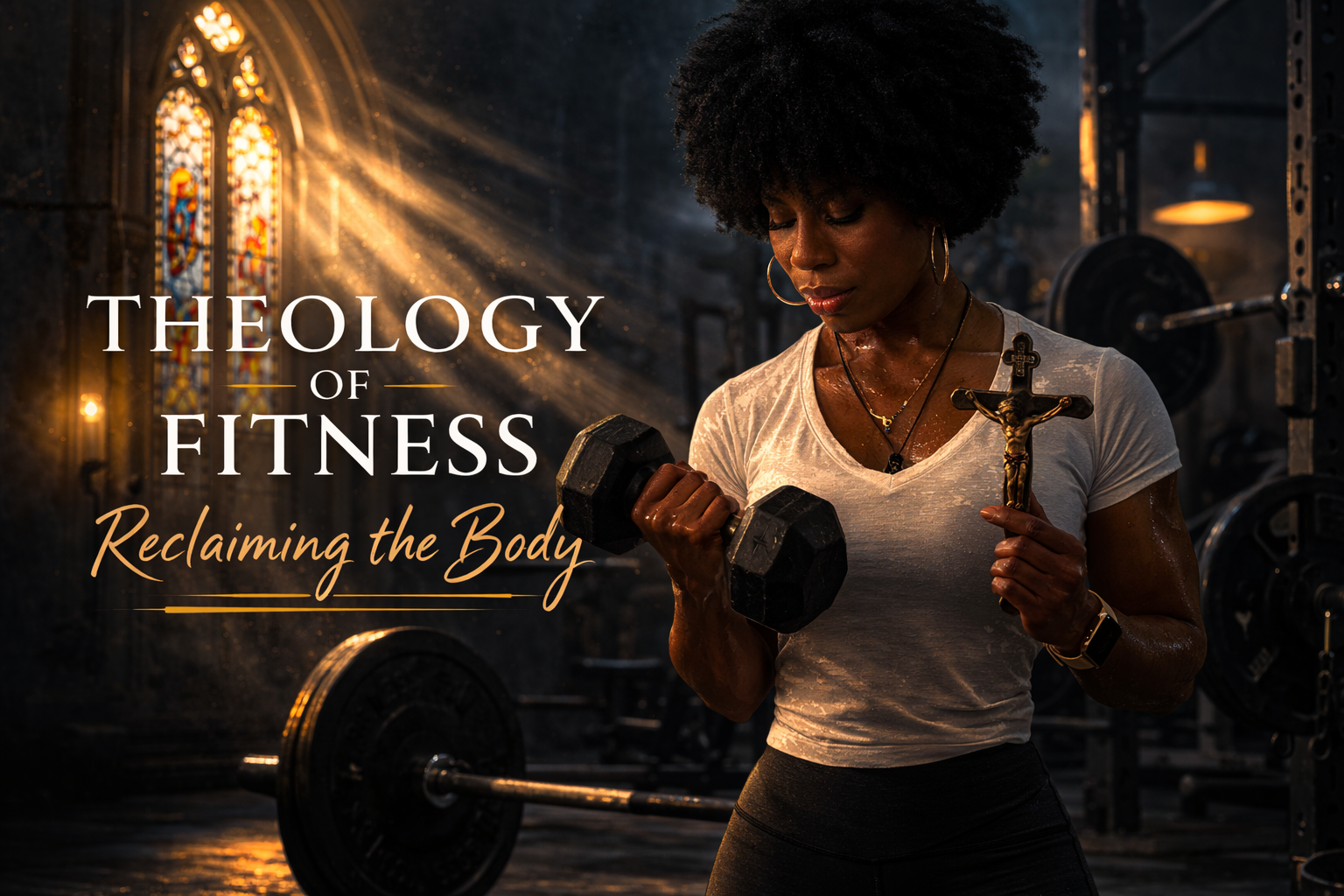
Theology of Fitness was born out of that tension. It is not a workout style or some coy marketing phrase. It is a framework rooted in Catholic anthropology that integrates physical training and spiritual formation.
Moreover, this work is my response to a fitness culture that has lost sight of the human person. It flows from my experience as a coach and IFBB Pro who has competed on the Olympia stage. At the same time, it is shaped by my formation as a Catholic woman deeply rooted in the life and teaching of the Church.
In this post, I want to define what Theology of Fitness is, expose the crisis that made it necessary, and lay the foundation for the Four Pillars that will shape everything we do here.
Because if we get the human person wrong, we will get fitness wrong.
And right now, we are getting it wrong.
The Modern Fitness Industry Has a Body Problem
I have been in this industry since 1997.
I have coached men and women through transformations, contest prep, off-seasons, rebuild phases, injury recoveries, and identity crises disguised as diet plans. As a competitor, I’ve stood on the Olympia stage. With passion and fire, I’ve trained competitors. Relatably, I’ve worked with everyday men and women trying to reclaim their health.
And what I have seen over the decades is this:
The fitness world does not know what to do with the body.
It swings between extremes.
The Machine Model
In one corner, the body is treated like a machine.
Fuel it. Track it. Optimize it. Upgrade it.
We talk about macros, output, recovery metrics, hormonal panels, and progressive overload. None of that is wrong in itself. In fact, much of it is necessary. The body has a biology. It responds to stimulus. It adapts to load.
But when the body becomes nothing more than a performance unit, something subtle happens. The person disappears.
You are no longer a human being. You are a data set.
When this mindset goes unchecked, fitness becomes transactional. If the machine performs, you are valuable. If it breaks down, you are a problem to fix.
Our bodies have become engulfed in reductionism.
The Church teaches clearly that the human person is a unity of body and soul. As the Catechism states in paragraph 362, “The human person, created in the image of God, is a being at once corporeal and spiritual.” The body is not a shell. It is not an accessory. It is part of who you are.
When we reduce the body to machinery, we reduce the person.
The Idol Model
In another corner, the body is an idol.
Aesthetic perfection becomes moral virtue. Leaner equals better. More shredded equals more disciplined. Bigger equals more powerful.
Social media has amplified this distortion. Physiques are curated. Lighting is manipulated. Angles are engineered. Filters are normalized.
And then comparison becomes constant.
Women feel pressure to shrink. Smaller waist. Thinner thighs. Tighter skin. Eternal youth. Value tied to desirability.
Men feel pressure to inflate. Bigger chest. Broader shoulders. Thicker arms. Visible dominance. Value tied to intimidation or aesthetic superiority.
Young men now talk openly about “looksmaxing” as if relationships are contracts negotiated on symmetry and body fat percentage. Teenage boys feel inadequate if they are not visibly muscular. Steroid use is creeping younger and younger because hyper muscularity has been normalized.
Different expressions. Same disorder.
The body becomes currency.
But Genesis 1:31 tells us that when God created the human person, He saw that it was “very good.” Not marketable or algorithm approved. Very good.
When we turn the body into an idol, we do not elevate it. We enslave ourselves to it.
The Enemy Model
There is a third distortion, and it hides behind discipline.
The body becomes the enemy.
It must be punished. Starved. Pushed. Silenced. Conquered.
This mindset often disguises itself as grit. As mental toughness. As grind culture.
But beneath it is often self contempt.
I have coached women who apologize for eating. Men who feel disgusted with themselves after a missed lift. Competitors who believe suffering alone sanctifies their prep.
Catholic tradition does speak about mortification. It speaks about discipline. It speaks about mastery over the passions. But it never teaches hatred of the body.
St. Paul writes in 1 Corinthians 6:19 to 20, “Do you not know that your body is a temple of the Holy Spirit within you… You are not your own; you were bought with a price. So glorify God in your body.”
You do not despise a temple; you care for it, order it, and sanctify your actions within it.
The body is not the enemy. Disordered desire is the enemy. Sin is the enemy. Pride is the enemy.
When we confuse these, we wage war on ourselves.
The Return of Dualism in Disguise
Underneath all three distortions is something older than Instagram.
Dualism.
Ancient philosophies like Platonism and Gnosticism treated the body as lesser, even corrupt. The soul was the real self. The body was something to escape.
Christianity rejected that. The Incarnation shattered that. “The Word became flesh” (John 1:14). Not an illusion of flesh. Flesh.
The Church has always taught the unity of body and soul. Gaudium et Spes, paragraph 14, states, “Though made of body and soul, man is one.” Not a soul trapped in a body. Not a body dragging around a soul. One.
The Catechism affirms in paragraph 365 that “the unity of soul and body is so profound that one has to consider the soul to be the ‘form’ of the body.”
But modern fitness culture has quietly reintroduced dualism.
We compartmentalize.
Spiritual life over here. Gym life over there.
Sunday Mass. Monday leg day. No connection.
Or worse, performance over here. Meaning nowhere.
Theology of Fitness rejects this fragmentation.
Because Romans 12:1 calls us to “present your bodies as a living sacrifice, holy and acceptable to God, which is your spiritual worship.”
Your body is not separate from worship. It is involved in it.
If we misunderstand that, everything fractures.
Pressure on Women and Pressure on Men
Let’s be honest.
This is not just a women’s issue. It is not just a men’s issue. It is a human issue.
Women are told they must be smaller, tighter, younger, softer but somehow also toned. They are pressured to remain visually desirable in every season of life. Pregnancy, menopause, aging. All treated as aesthetic threats.
Men are told they must be larger, more imposing, visibly muscular, always strong. Emotional restraint is confused with emotional suppression. Physical dominance becomes a substitute for interior strength.
Both are exhausting and are rooted in insecurity.
Both ignore the deeper question of dignity.
The Church teaches that our dignity comes from being made in the image and likeness of God (Genesis 1:27), not from symmetry. Not from leanness or from mass.
When identity is detached from Imago Dei, the body becomes a project to justify existence.
And that is too heavy a burden for flesh to carry.
Movement One exposes the crisis.
We have reduced the body to a machine, an idol, or an enemy. And in this process, we’ve resurrected dualism in subtle forms. Make no mistake, we’ve placed crushing aesthetic pressure on men and women alike.
The result is a fitness culture that forms physiques but fragments persons.
Theology of Fitness begins by saying no to that fragmentation.
In the next movement, we will rediscover what the Church actually teaches about the human person and why the Incarnation changes everything about how we train, eat, discipline, and pursue excellence.
Because until we recover a correct vision of the body, we will continue to misuse it.
And that is where everything shifts.
The Revelation: Rediscovering the Body as Sacred
If the crisis in modern fitness is a misunderstanding of the human person, then the solution cannot be another program.
It has to be a recovery of truth.
The turning point for me was not discovering a new training split.
It was rediscovering what the Church has always taught about the body.
The Body Is Not an Accessory to the Spiritual Life
Many Catholics live as if the spiritual life floats above the physical one.
We pray.
>We go to Mass.
>We receive the sacraments.
And then we go to the gym as if we have stepped into a neutral zone where theology no longer applies.
That compartmentalization is not Catholic.
The Incarnation alone destroys it.
John 1:14 says, “And the Word became flesh and dwelt among us.”
God did not save us from a distance. He assumed a body in our Lord Jesus Christ. Our Lord grew, walked, and ate. He suffered, bled, and He died.
If the body were irrelevant, Christ would not have taken one.
If the body were disposable, He would not have risen in it.
Luke 24 shows us the resurrected Christ eating with His disciples. He is not a ghost nor is He pure spirit. He is glorified, yes, but embodied.
Christianity is not an escape from flesh. It is the redemption of it.
The Catechism teaches in paragraph 365 that the unity of soul and body is so profound that the soul is the form of the body. We are not souls trapped inside biological containers. We are embodied persons.
Gaudium et Spes, paragraph 22, reminds us that “Christ fully reveals man to himself.” That means if you want to understand the human body, you look to Christ.
And Christ dignifies the body by entering it.
This changes how we train.
Because if the body is part of the person, then forming the body is part of forming the person.
Christian Morality and Human Flourishing
There is another layer here that modern culture forgets.
Freedom without truth collapses.
We are told constantly that autonomy is the highest good. That discipline is oppression. That limits are arbitrary.
But the Church has always taught that moral truth is not restrictive. It is liberating.
In Veritatis Splendor, paragraph 84, St. John Paul II writes that authentic freedom is found in adherence to truth. Not self invention. Not impulse. Truth.
This applies to the body.
Rerum Novarum speaks of Christian morality, when adequately practiced, leading not only to eternal life but also to temporal prosperity. Virtue orders the person. It tempers passions. It disciplines desire.
Temperance, fortitude, prudence. These are not abstract spiritual concepts. They shape how we eat. How we train. How we rest.
When I began to see training not merely as physical exertion but as an arena for virtue, everything shifted.
The grind was no longer ego driven.
Discipline became an offering.
Mortification was no longer punishment. It was ordered love. Saying no to disordered impulses in order to say yes to a higher good.
Romans 12:1 calls us to present our bodies as a living sacrifice. Not a dead one. Not a neglected one. A living sacrifice.
That implies intentionality.
It implies stewardship.
It implies integration.
Grace Builds on Nature
There is a foundational principle in Catholic theology that anchors everything we are talking about here: grace builds on nature. God does not bypass what He has created. He doesn’t discard it nor treat it as disposable raw material.
Jesus perfects it. He elevates it, and more importantly, He heals it.
This is not a minor theological detail. It is a lens through which we must understand the human body.
In Dei Verbum, the Church teaches that God reveals Himself in ways that invite human response. Revelation does not override our humanity – it engages it. It speaks to us as embodied persons. And, it calls forth intellect, will, memory, and desire. The supernatural life does not float above our physical existence. It enters into it and transforms it from within.
- Your body has a nature.
- It responds to stimulus.
- It adapts to resistance.
- It grows stronger under progressive load.
These are not spiritually neutral facts. They are part of the order God inscribed into creation. Physiology is not opposed to holiness. Biology is not competition for grace.
There is nothing unspiritual about wanting to be strong. There is nothing worldly about respecting the structure of muscle tissue, understanding recovery cycles, or programming intelligently. What becomes disordered is not strength itself. It is strength detached from its proper end.
When training is ordered toward vanity, comparison, or domination, it deforms the person because it isolates the body from its deeper purpose.
But when training is ordered toward stewardship, service, excellence, and virtue, it forms the person because it aligns nature with grace. The same deadlift can either feed pride or cultivate fortitude. The difference is not in the movement. It is in the meaning.
Theology of Fitness does not reject science.
It refuses to reduce the human person to science alone. We care about biomechanics. Yes, we understand muscle fiber recruitment, respect progressive overload, and nervous system adaptation. But we also recognize that performance is not ultimate. Longevity without eternity is incomplete. Aesthetic excellence without virtue is hollow.
Integration is the goal. Not abandonment of the physical, and not absolutizing it. Integration.
From Compartmentalization to Integration
Theology of Fitness emerged from the realization that the fragmentation we see in modern culture is not accidental. It is the fruit of compartmentalization.
We have learned to divide our lives into categories that never touch.
Faith in one box. Fitness in another.
Moral formation over here. Macros and training splits over there.
But the body and soul are not competitors.
They are not two parallel tracks running alongside each other. They are one reality.
As the Catechism teaches, the unity of body and soul is so profound that we must consider the soul the form of the body. That means what happens in the body touches the soul, and what happens in the soul touches the body. There is no neutral territory.
The gym and the sanctuary are not rival arenas. They are different spaces in which the same person stands before God.
If Christ reveals man to himself, as Gaudium et Spes teaches, then every arena of human action must be illuminated by that revelation, including physical training.
Theology of Fitness is the disciplined integration of physical training and spiritual formation rooted in Catholic anthropology.
It is the conviction that because the human person is a unity of body and soul, the formation of one necessarily touches the other. Refuses both aesthetic obsession and disembodied spirituality. And, it refuses self-improvement culture masquerading as sanctification.
Moreover, it refuses the idea that we can pursue physical excellence while neglecting interior conversion.
When you endure a hard set with composure instead of quitting at the first sign of discomfort, you are not only building muscle.
You are forming fortitude.
When you approach your nutrition with prudence instead of impulse, you are not only managing body fat. You are forming discipline. When you refuse comparison and anchor your identity in the truth that you are made in the image and likeness of God, you are not only protecting your mental health.
You are forming humility.
Training becomes formation because the person is unified. Sweat becomes offering when it is consciously placed before God. Rest becomes trust when it is received as part of the created order rather than resisted as weakness.
The crisis in fitness began with forgetting who we are. The renewal begins with remembering. And once we recover that vision, we need a concrete structure to live it out in daily practice.
That is where the Four Pillars come in.
The Framework: The Four Pillars of Theology of Fitness
Recovering a correct vision of the human person is essential, but vision alone is not enough.
It must take shape in daily practice.
It must enter into how we train, how we think, how we regulate our emotions, and how we pray. Without structure, even the most beautiful theology remains abstract.
Theology of Fitness rests on four integrated pillars: Physical, Mental, Emotional, and Spiritual Fitness. These are not separate lanes. They are dimensions of the same unified person. Each pillar supports the others. When one collapses, the entire structure weakens.
Physical Fitness
Physical Fitness is the most visible pillar, but it is not the ultimate one.
It is the disciplined cultivation of strength, endurance, mobility, coordination, and resilience according to the natural laws written into the body.
Theology of Fitness takes physiology seriously because the body is not imaginary. It has structure, limits, and capacity.
Catholic tradition has never despised the body. In fact, it has defended its dignity against every philosophy that attempted to diminish it. The Catechism teaches that the body shares in the dignity of the image of God (CCC 364). That means training is not cosmetic maintenance. It is stewardship.
To steward something well, you must understand it. That is why Theology of Fitness embraces sound programming, progressive overload, intelligent periodization, recovery cycles, and nutritional discipline. Not because aesthetics are god, but because excellence is a form of reverence. Sloppiness is not a virtue. Neglect is not humility.
Physical strength, rightly ordered, is not vanity. It is capacity – the capacity to serve.
The capacity to endure, to show up fully in one’s vocation.
St. Paul writes in 1 Timothy 4:8 that “bodily training is of some value,” and he does not dismiss it. He situates it. It has value, but it is not absolute.
When physical fitness is severed from virtue, it becomes obsession. When it is integrated into a life of grace, it becomes formation.
Mental Fitness
The modern world fractures attention. It fragments focus and rewards distraction. Mental Fitness in the Theology of Fitness framework is the disciplined cultivation of clarity, resilience, and ordered thought.
Romans 12:2 exhorts us, “Do not be conformed to this world, but be transformed by the renewal of your mind.”
That renewal does not happen accidentally.
It requires intentional resistance to comparison culture, algorithm driven insecurity, and the constant noise that erodes interior stability.
Training is not only physical exertion. It is mental rehearsal. It’s learning to push through discomfort without panic, and essentially, choosing discipline over impulse. It is resisting the narrative that you are your last failure.
A person who cannot regulate their thoughts will struggle to regulate their body.
A person who constantly indulges comparison will never find contentment in progress. Mental Fitness means learning to think in alignment with truth. It means recognizing distorted self perception and replacing it with reality grounded in Imago Dei.
You are not your body fat percentage or your last lift. You are not your reflection under bad lighting.
Mental discipline reinforces physical discipline, and both must be illuminated by truth.
Emotional Fitness
Emotions are not enemies. They are movements of the passions. But without formation, they dominate.
The Catechism teaches that the passions are morally neutral in themselves, but they become good or evil depending on whether they are governed by reason and ordered toward the good (CCC 1767).
Emotional Fitness is the cultivation of that governance.
In fitness culture, emotional extremes are common. Shame after a missed workout. Pride after a good one. Anxiety over weight fluctuations. Irritability during prep. Identity swings tied to aesthetic changes.
Without formation, the body becomes the trigger for emotional instability.
Theology of Fitness calls for integration.
Fortitude steadies discouragement. Temperance moderates impulse. Prudence discerns when to push and when to rest. These are not abstract virtues. They are lived daily in the gym, at the table, and in recovery.
Emotional Fitness does not suppress feeling. It orders it and allows joy in progress without idolatry. It allows frustration without despair and ambition without pride.
A strong body with ungoverned passions is fragile. A trained emotional life stabilizes the entire person.
Spiritual Fitness
Spiritual Fitness is the animating core. Without it, the other pillars drift.
This pillar is rooted in prayer, sacramental life, virtue, and the conscious offering of daily actions to God. It is here that integration becomes explicit. Training is no longer merely a health practice. It becomes a field of sanctification.
Romans 12:1 calls us to present our bodies as a living sacrifice. That includes how we train. St. Josemaría Escrivá emphasized the sanctification of ordinary work, teaching that holiness is found in the faithful performance of daily duties offered to God.
The gym can be one of those places.
Spiritual Fitness reminds us that the ultimate goal is not six percent body fat. It is union with God that does not reject excellence. It orders it.
Prayer guards identity. The sacraments ground dignity. Confession humbles pride. The Eucharist reorients desire. When spiritual life is strong, aesthetic fluctuations lose their tyrannical power.
Spiritual Fitness does not replace the other pillars. It purifies them.
Why This Framework Matters Now
We live in a moment of intense confusion about identity, embodiment, and value. Social media amplifies comparison. Biohacking promises immortality without reference to eternity. Disembodied spirituality floats free from physical responsibility.
Hyper materialism denies transcendence.
If we do not recover a correct vision of the human person, fitness will continue to deform rather than form us. It will continue to produce impressive physiques with fragile identities. It will continue to oscillate between obsession and neglect.
Theology of Fitness offers a different path. Not a softer one. Not a less disciplined one. A more integrated one.
It insists that excellence and humility can coexist. That strength and surrender are not opposites. That discipline and joy belong together.
What You Can Expect Here
On this platform, you will find training grounded in science and formation grounded in Catholic truth. You will find conversations about programming and virtue, about nutrition and temperance, about aesthetics and identity. You will not find a rejection of physical excellence, nor will you find its idolization.
Because the human person is integrated.
Theology of Fitness is not a trend. It is a recovery. It is a return to a vision the Church has always held but that modern culture has forgotten.
Train the body. Strengthen the will. Grow in virtue. 💪🏿
[…] to join EWTN’s Beacon of Truth with Deacon Harold Burke-Sivers for a four day deep dive into Theology of Fitness — a groundbreaking approach to an integrated faith and fitness life rooted in Catholic […]
[…] to join EWTN’s Beacon of Truth with Deacon Harold Burke-Sivers for a four day deep dive into Theology of Fitness — a groundbreaking approach to an integrated faith and fitness life rooted in Catholic […]